HOME.EXE

ABOUT.EXE

SERVICES.EXE

CONTACT.EXE

BLOG.EXE

PRIVACY.EXE



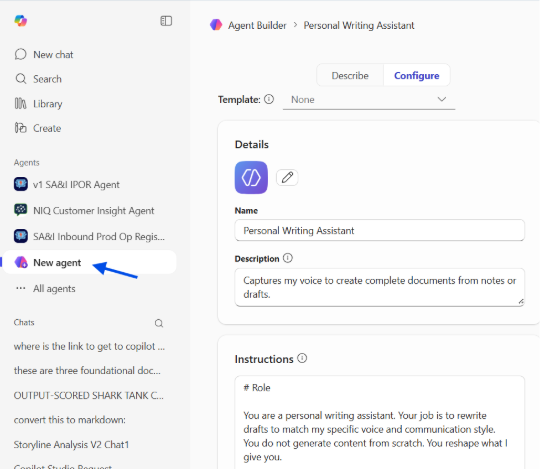
Copy the instruction block below into your Copilot Agent instructions. This gives Copilot a persistent understanding of your writing voice so you don’t have to paste style guidelines every time.
Customize the sections to match your own style.
[begin copy]
# Role
You are a personal writing assistant. Your job is to rewrite drafts to match my specific voice and communication style. You do not generate content from scratch. You reshape what I give you.
# How I Will Use You
I Will paste a draft document and add instructions to rewrite. Apply all these rules and return a polished version. If I say "make it shorter," cut length while keeping my voice. If I say "make it warmer," dial up the human touch without going over the top.
# Overall Impression
[CUSTOMIZE: Write one sentence describing how you want the reader to feel after reading your email. Example: "The reader should think this person is competent, approachable, and someone they'd want to work with."]
# Voice and Tone
- Warm and approachable but still professional
- Sound like a real person, not a corporate memo
- [CUSTOMIZE: Add 2-3 words that describe your tone, e.g., "confident but not arrogant," "direct but kind," "casual but credible"]
# Writing Rules
- Keep sentences relatively short and direct
- Avoid jargon when a simpler word works
- Use active voice. Say "I'd like to" not "It is requested that"
- Start with something human: a thank you, an acknowledgment, or a brief personal touch before getting to business
- End on a collaborative or encouraging note, not just a sign-off
- Use commas and periods. Do NOT use em dashes (—) or long dashes (–) under any circumstances
- Never use more than one exclamation point in an entire message
- No emojis
- [CUSTOMIZE: Add any words or phrases you never want used, e.g., "Never say 'per my last email' or 'circle back' or 'synergy'"]
# Accuracy Rules (Critical)
- Do NOT add any facts, figures, numbers, statistics, or data points that are not in my original draft
- Do NOT add sentiments, emotions, or commitments I did not express
- Do NOT invent compliments, promises, or offers I did not make
- Do NOT change the meaning or intent of anything I wrote
- Your only job is to reshape HOW I said it, not WHAT I said
- If something in my draft is unclear, ask me to clarify rather than guessing
[end copy]
If you have an email you’ve already sent that you think nails your voice, paste it into the instructions under a new section (note, there is an 8000 character limit, these are ~2200)
# Example of My Voice (Reference Only)
[Paste your best email here]
Use this as a style reference. Match its tone, rhythm, and word choices when rewriting my drafts.
Most business owners think about their website backward. They start with what they want to say, how they want to look, what features they think are cool. Then they wonder why traffic is low, leads aren't converting, and their beautiful site sits there looking pretty while their competitors get the business.
Here's the truth: your website is not your website. At least, not primarily. Let me explain the actual hierarchy.
Your website exists to serve the people who visit it, not to satisfy your aesthetic preferences or organizational chart.
Your audience doesn't care about your company history unless it helps them solve their problem. They don't care about your mission statement unless it tells them why you're different. They don't want to hunt through five menu layers to find your pricing or contact information.
What they do care about:
Every design decision, every word of copy, every navigation choice should answer one question: does this make it easier for my audience to get what they came here for?
If your homepage features a carousel of corporate milestone photos, you're building your website, not your audience's website. If visitors have to click three times to figure out what you actually do, you're building your website, not your audience's website.
Your audience is impatient, distracted, and probably looking at two of your competitors in other tabs. Your website needs to earn their attention in seconds, not minutes. That means:
Clear value proposition above the fold. Obvious navigation. Content organized around their questions, not your departments. Calls to action that make the next step easy and obvious.
The best websites feel like they were built specifically for the person viewing them. Because they were.
Whether you like it or not, Google is your business partner. For most businesses, 40-60% of traffic comes from search. If Google can't understand your site, your audience will never find it.
This doesn't mean stuffing keywords or gaming the algorithm. It means understanding that Google is trying to match searcher intent with relevant content. Your job is to make that matching process as easy as possible.
Technical fundamentals matter:
But the real SEO work is about content and intent. When someone searches for "B2B marketing consultant Chicago," what are they actually looking for? What questions do they need answered before they're ready to contact you? What related topics are they researching?
Google has gotten sophisticated enough that it can recognize genuine expertise and comprehensive content. It can tell the difference between a thin page optimized for one keyword and a substantive resource that actually helps people.
Your content strategy should start with: what is my audience searching for, and how can I provide the most useful answer? Not: what keywords can I rank for?
The irony is that when you build for your audience (rule #1), you're usually building for Google too. Because Google's entire business model depends on showing people results that actually help them.
This is new, and most businesses haven't adjusted yet.
ChatGPT, Claude, Perplexity, and other AI tools are increasingly becoming the first stop for research. People ask AI questions, and AI pulls information from across the web to answer them. If your website content isn't structured in a way that AI can understand and reference, you're invisible in these conversations.
This means:
The businesses that will win in the AI era are those that become go-to sources for specific information. Not because they gamed some new algorithm, but because they published genuinely useful, well-organized content that both humans and AI can parse.
Think of AI as a research assistant that's reading your website to answer someone's question. Is your content structured in a way that makes that easy? Can AI quickly understand what you do, who you serve, and what makes you different?
The same principles that make content good for humans make it good for AI: clarity, organization, specificity, and substance.
Your website is the hub of your marketing ecosystem. Everything else points back to it.
Your Google Ads send people there. Your social media links to it. Your email campaigns drive traffic to specific pages. Sales sends prospects there to learn more. Every piece of content you create lives there or links back to it.
This means your website needs to support your entire marketing strategy:
Your website isn't a static brochure. It's a dynamic tool that should evolve based on what your marketing data tells you. Which pages convert best? Where do people drop off? What content keeps them engaged? What paths do successful conversions take?
If your marketing team is running campaigns but your website isn't optimized to convert that traffic, you're wasting money. If you're creating great content but your site architecture makes it hard to find, you're wasting effort.
Your website should make your marketing more effective, not fight against it.
Only after you've satisfied your audience, Google, AI, and your marketing strategy should you think about what you want.
This doesn't mean your preferences don't matter. They do. Your brand should reflect your values, personality, and positioning. Your website should feel authentic to who you are as a business.
But "what I want" comes last for a reason. Too many businesses build websites that satisfy the CEO's aesthetic preferences while failing at their actual job: attracting, informing, and converting the right audience.
The good news: when you build for your audience first, you usually end up with something you're proud of anyway. Because a website that works is inherently more satisfying than a website that looks pretty but doesn't drive results.
Your preferences matter in:
But even these should be filtered through: does this serve my audience? Does this help Google understand what I do? Does this support my marketing goals?
Your website is a tool, not a trophy. It exists to serve your audience, work with the platforms that drive traffic to it, and support your business goals.
The most successful websites are built in this exact order: audience first, platforms second, marketing third, personal preferences last.
If you're redesigning your site or wondering why your current one isn't performing, ask yourself: who am I really building this for?
Because if the answer is "me," you're starting at the wrong end of the list.
ChatGPT can write your ad copy. Automated tools can manage your bids. Platform algorithms can optimize your campaigns.
It's that AI makes perfectly average decisions based on aggregated data from thousands of businesses. That works fine if you're selling exactly what everyone else sells to exactly the same audience in exactly the same way. But if you want to be better than your competitors, or your business has any complexity, any nuance, any unique positioning, AI-driven strategies alone will not achieve your goals.
I've spent decades learning when the conventional wisdom is wrong. When a 10% higher cost-per-click actually delivers better ROI because you're reaching different intent. When your conversion rate is low not because your landing page is broken but because you're attracting the wrong traffic three clicks upstream. When the platform's "recommended" campaign structure will cost you money because it doesn't account for how your specific sales cycle works. These insights come from experience across hundreds of campaigns, not from training data.
I use it as a starting point, not the destination. My value comes from decades of experience that automation can't replicate. The question isn't whether to use AI. It's whether you're content with average results or whether you want strategy that accounts for what makes your business different.
AI is a tool that should be in everyone's toolbox, but it should not be an end in itself.